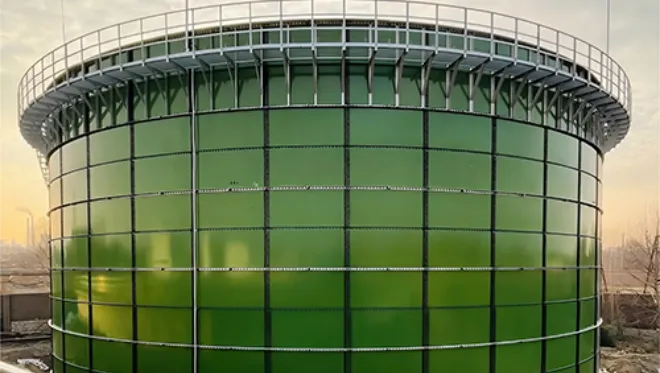
Municipal facilities, industrial plants, farms, and fire-protection systems often require more storage capacity than a small factory-made tank can provide. Transporting a fully assembled tank may also be difficult because of site access and lifting conditions.
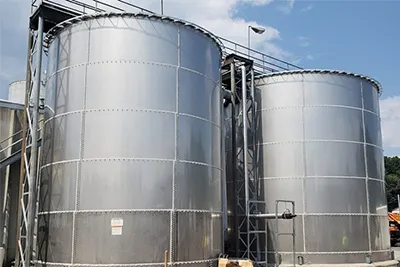
A corrugated steel water tank addresses this challenge through a circular, bolted structure assembled from prefabricated steel panels. The components can be shipped in compact packages and installed at the final site, allowing the diameter, height, and capacity to be adapted to project requirements.
A modular tank can also be dismantled or relocated when the design permits. Its performance still depends on correct foundation preparation, liner selection, roof design, and installation quality.
Why Corrugated Steel Panels Are Used for Round Tanks
The wall of a corrugated steel water tank is made from profiled galvanized or Zincalume steel panels connected with high-strength bolts. Corrugations increase panel stiffness and help the circular wall distribute water pressure around the tank.
JOVIA uses Q235 galvanized or Zincalume panels manufactured according to GB/T 700-2006, together with 8.8-grade bolts. Its product page lists steel thicknesses from 0.8 to 1.6 mm, although the final specification should match the tank dimensions and structural loading.
The round arrangement also avoids the concentration of corners found in rectangular systems. For large outdoor projects, diameter and height can be adjusted to balance capacity, available land, and foundation requirements.
How the Steel Shell and Waterproof Liner Work Together
The steel panels provide structural support, while an internal membrane contains the stored water. JOVIA lists an anti-aging PVC liner of approximately 0.75 mm and rubber lining options from 0.75 to 1.00 mm. Its product introduction also notes PVC liner options between 0.8 and 1.2 mm for project-specific configurations.
This separation of functions is important. The steel shell resists structural forces, while the liner creates the waterproof barrier. Buyers should confirm liner compatibility with the intended water, operating temperature, cleaning process, and required approvals.
Pipe penetrations, overflow connections, and drains must be sealed according to the supplier’s installation method. A damaged or incorrectly fitted liner can undermine the performance of an otherwise strong corrugated water tank.
Common Applications of Corrugated Steel Water Storage Tanks
The modular circular design makes corrugated steel water storage tanks suitable for projects requiring medium or large capacities. Typical applications include:
Irrigation and farm water storage
Municipal and rural water supply
Fire-protection reserves
Rainwater harvesting
Industrial process or cooling water
Emergency water supply
Potable water with a suitable liner
Aquaculture and fish farming
These applications are included among the intended uses of JOVIA’s corrugated tank system. The product can be customized by diameter, height, and storage capacity according to project requirements.
For agricultural projects, corrugated steel rainwater tanks can collect seasonal rainfall for irrigation or utility use. The roof, inlet screening, and overflow route should be planned according to the climate and intended water use.
For factories and commercial sites, the tank may hold fire water, cooling water, or standby utility water. Buyers comparing several systems can review JOVIA’s broader storage tanks range, which includes corrugated, GRP, stainless steel, glass-fused, and epoxy-coated options. For smaller rectangular installations or restricted-access plant rooms, buyers can also compare a grp sectional water tank with the circular corrugated system.
Although searches sometimes use the term corrugated steel water trough, a large circular storage tank is not automatically a livestock drinking trough. Any separate trough and discharge arrangement should be designed around animal access, hygiene, and flow requirements.
Capacity, Foundation and Roof Planning
A large corrugated water storage tank should be sized from usable demand rather than nominal volume alone. The project team should consider peak consumption, refill rate, emergency reserve, freeboard, and unusable volume below the outlet.
Before preparing a quotation, the supplier normally needs:
Required usable capacity
Preferred diameter and maximum height
Indoor or outdoor installation
Water source and intended use
Inlet, outlet, overflow, and drain sizes
Local wind and seismic conditions
Foundation information
Roof and access requirements
Delivery destination and installation scope
JOVIA offers steel-structure roofs, fixed plastic-film covers, and floating-film options. Roof selection should reflect water quality, debris control, evaporation, and access requirements.
The foundation must be level and capable of carrying the full operating load, including stored water, the steel shell, liner, roof, and fittings. Foundation details should be confirmed before delivery rather than adjusted during assembly.
The relationship between diameter and height also affects project planning. A wider, lower tank requires more land but may reduce overall wall height. A narrower, taller tank can save ground space but may require a different panel, foundation, and structural configuration.
Corrosion Protection and Maintenance
JOVIA’s tanks use galvanized or Zincalume panels to improve resistance to corrosion and outdoor exposure. The internal liner also separates stored water from the metal shell under normal service conditions.
Routine inspection is still necessary. Operators should check bolts, panel surfaces, liner condition, roof components, pipe connections, and the surrounding foundation. Standing water and aggressive chemicals should not remain against the external shell.
JOVIA describes the tanks as movable, reusable, and customizable, with fast installation and relatively low labor requirements. These benefits depend on correct site preparation and assembly according to approved drawings.
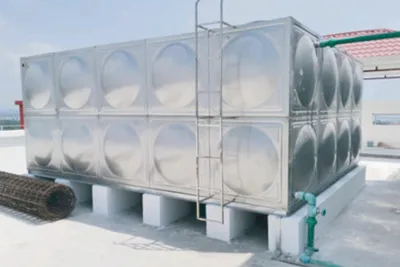
Where a project requires rectangular pressed panels rather than a circular liner tank, hot-dip galvanized water tanks may provide an alternative modular configuration. Where a project requires rectangular pressed panels rather than a circular liner tank, a galvanized steel water tank may provide the preferred modular configuration.
What to Compare When Reviewing Corrugated Water Tanks for Sale
When evaluating corrugated water tanks for sale, buyers should compare complete systems rather than only steel price or nominal capacity. A quotation should identify:
Steel grade, coating, and panel thickness
Bolt grade and connection method
Liner material and thickness
Tank diameter, height, and usable volume
Roof type and access openings
Pipe fittings and nozzle positions
Foundation requirements
Freight and installation services
Warranty and maintenance guidance
A lower quotation may exclude the liner, roof, fittings, installation supervision, or foundation work. Defining the project scope allows contractors to compare suppliers on an equivalent basis.
Buyers should also clarify whether unloading, civil construction, installation tools, on-site labor, and commissioning are included. For international projects, packing methods and shipping-container utilization can significantly affect the final delivered cost.
FAQ About Corrugated Steel Water Tanks
What is the main advantage of a corrugated steel water tank?
Its main advantage is modular large-capacity storage. Prefabricated panels can be shipped efficiently and assembled on site, while the diameter and height can be customized for the required volume.
Can corrugated steel tanks store potable water?
They may be used for drinking-water storage when the liner, fittings, and complete system meet applicable project and local requirements. Potable-water suitability should be confirmed before ordering.
Are corrugated steel tanks suitable for rainwater harvesting?
Yes. Corrugated steel rainwater tanks can provide substantial storage for harvested rainwater. The system should also include suitable inlet filtration, overflow control, roof protection, and water-management measures.
Can the tank be relocated?
JOVIA describes its corrugated tank as movable and reusable. Practical relocation depends on the tank condition, liner, dismantling method, new foundation, and replacement sealing components.
Is a galvanized round water tank the same as a corrugated steel tank?
The terms may overlap, but they are not always identical. A galvanized round water tank may refer broadly to any circular galvanized tank, while JOVIA’s product specifically uses corrugated bolted panels with an internal waterproof liner.
Conclusion
A corrugated steel water tank provides a flexible solution for agricultural, municipal, industrial, fire-water, and rainwater-storage projects requiring substantial capacity. Its circular bolted structure supports efficient transport and on-site assembly, while the liner provides the waterproof barrier.
JOVIA supplies customizable corrugated steel tanks using galvanized or Zincalume panels, high-strength bolts, and PVC or rubber liners. Buyers can submit capacity, site dimensions, water use, roof requirements, and connection details to receive a project-specific configuration and quotation.
 English