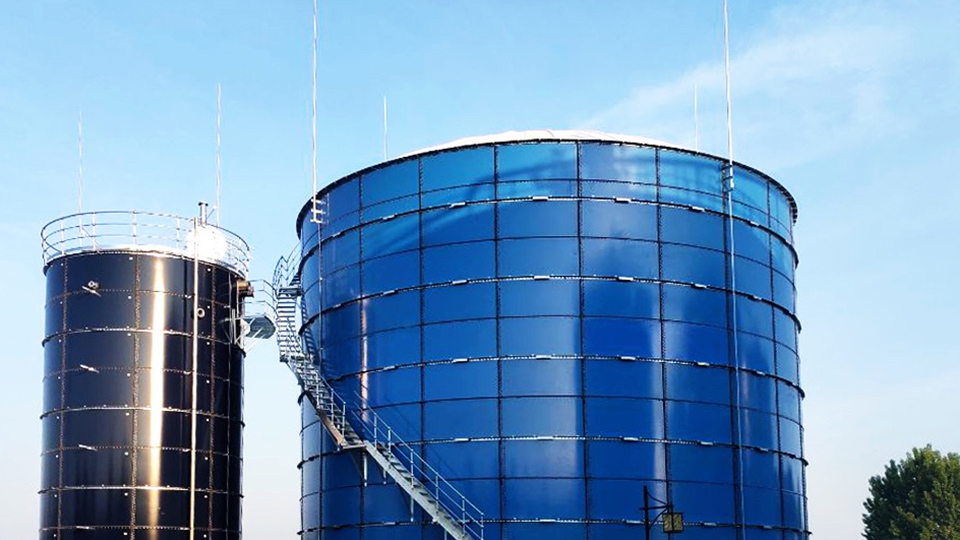
Reliable water storage is essential for fire-protection systems, industrial facilities, commercial buildings, agricultural projects, and municipal infrastructure. In these applications, the tank must provide sufficient capacity while remaining practical to transport, install, and maintain.
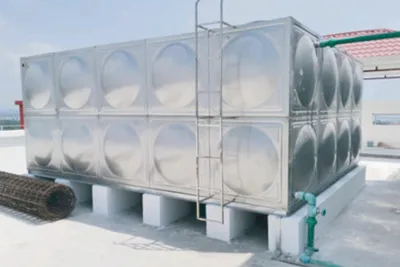
A hot dip galvanized water tank combines a pressed-steel panel structure with a protective zinc coating. The individual panels are manufactured in a factory, transported to the project site, and connected by bolts rather than welded together on site. This modular construction allows the tank dimensions to be adapted to different capacities and installation spaces.
For contractors and project owners, the main value of a galvanized tank lies in its combination of structural strength, corrosion protection, dimensional flexibility, and convenient on-site assembly.
How Does a Hot-Dip Galvanized Water Tank Work?
A hot dip galvanized water tank is assembled from pressed steel panels, structural supports, sealing rubber, bolts, flanges, and a supporting base frame. After the steel components have been formed, they are immersed in molten zinc so that a protective zinc layer develops across the exposed surfaces.
The zinc layer helps isolate the underlying steel from moisture and environmental exposure. However, the performance of the complete tank also depends on panel thickness, joint sealing, internal supports, foundation preparation, and correct installation.
JOVIA manufactures its panels from Q235B steel and lists a zinc-layer thickness of 70 μm. Its standard panel dimensions include 1.22 × 1.22 m, 1 × 1 m, 1 × 0.5 m, and 0.5 × 0.5 m. These panel combinations allow different tank dimensions to be configured according to the available space and required storage volume.
Why Pressed Steel Panels Are Used
A hot dipped galvanized pressed steel tank uses formed panels rather than completely flat steel sheets. Pressing creates a defined panel profile that improves structural stiffness and helps the walls resist hydrostatic pressure.
Panel thickness should increase where water pressure is greater. The lower sections of a tall tank usually experience higher pressure than the upper sections, so the final panel and reinforcement arrangement must be engineered according to the tank height and capacity.
JOVIA states that its pressed panels are manufactured using an integrated hydraulic-forming process without welded seams at the panel corners. The published material results include tensile strength of 509 MPa and yield strength of 414 MPa. The maximum listed tank height is five meters.
A project specification should therefore define more than the nominal capacity. It should also cover tank height, panel layout, internal reinforcement, foundation loading, and connection positions. For very large outdoor capacities and circular layouts, a corrugated water tank may be more suitable than a rectangular pressed-panel system.
Modular Installation Without On-Site Welding
One of the principal benefits of a hot dipped galvanized water tank is bolted assembly. Factory-produced panels can be packed for transport and assembled at the final location without welding the complete tank structure on site.
This is useful for projects where access routes, construction schedules, or site conditions make delivery of a one-piece tank impractical. Individual panels can be moved through normal access openings and assembled inside plant rooms or designated outdoor areas.
A typical tank system may include:
Inlet and outlet flanges
Drain and overflow connections
Manhole and inspection access
External ladder
Internal structural supports
Tie rods and support plates
Sealing rubber
Base frame and water-level indicator
JOVIA lists food-grade white EPDM or silicone as sealing options and provides galvanized bolts, nuts, flanges, and internal structural components. The company also states that construction drawings, installation videos, and installation plans can be supplied.
Applications of Galvanized Steel Water Tanks
A galvanized steel water tank is commonly considered where a project requires a strong, modular, and cost-conscious water-storage system.
Fire-Protection Water Storage
Fire-water tanks must maintain a defined reserve for emergency use. Industrial sites, warehouses, commercial complexes, and infrastructure facilities may use galvanized tanks as part of their fire-suppression systems.
The tank capacity, outlet arrangement, and usable water level must be coordinated with the fire-system design. JOVIA identifies fire protection as one of the principal applications of its broader storage tanks range.
Industrial and Utility Water
Factories may require stored water for processing, equipment cooling, cleaning, standby supply, or other utility requirements. A galvanized water storage tank can be configured around the available installation footprint and connected to the facility’s existing pipework.
The stored liquid and operating conditions should always be disclosed to the supplier. Standard water tanks should not automatically be specified for chemicals, high-temperature liquids, or wastewater with aggressive characteristics.
Agricultural and Rainwater Storage
Galvanized tanks may also be used for irrigation reserves, livestock water, farm utilities, and galvanized rainwater collection tanks. The roof, inlet filtration, overflow arrangement, and water treatment requirements should be planned according to the intended use.
Capacity and Dimension Planning for Large Tanks
The required storage capacity should be calculated from project demand rather than selected from a generic product-size list. Small searches such as “100 gallon galvanized water tank” or “500 gallon galvanized water tank” may relate to residential or retail products and do not accurately represent the modular systems used in large commercial projects.
For large galvanized water tanks, the supplier normally requires:
Required usable capacity
Maximum available length, width, and height
Indoor or outdoor installation
Foundation dimensions and load capacity
Inlet, outlet, overflow, and drain positions
Water use and operating temperature
Required design standards
Wind, snow, or underground loading conditions
Installation and supervision requirements
JOVIA states that its standard panel combinations can be assembled into capacities ranging from 0.125 m³ to 5,000 m³. The final dimensions and structural arrangement should still be verified through project-specific technical drawings.
What Affects Galvanized Water Tank Prices?
The price of a modular tank cannot be determined by storage capacity alone. Two systems with the same volume may have different costs because of their height, panel distribution, reinforcement, accessories, and installation conditions.
Factors affecting galvanized water storage tanks for sale include:
Required tank capacity and dimensions
Panel thickness and zinc specification
Internal or external support arrangement
Base-frame treatment
Number and size of pipe connections
Access ladders, manholes, and level indicators
Above-ground or underground design
Freight destination
Installation or technical-supervision scope
When reviewing galvanized steel water tanks for sale, buyers should confirm whether the quotation includes panels, bolts, sealing materials, internal supports, base frames, and standard accessories. A low initial tank price may not include all the components required for installation.
When a Different Steel Tank May Be More Appropriate
Hot-dip galvanized pressed-steel tanks provide modular rectangular storage, but they are not the only option for every project.
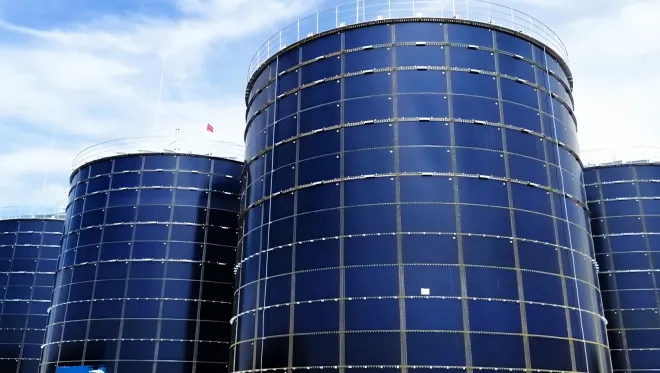
Where a circular design, liner system, or very large outdoor capacity is preferred, a corrugated steel water tank may offer a more appropriate structure. JOVIA’s corrugated models use galvanized or Zincalume panels with a PVC or rubber waterproof liner and can be customized by diameter, height, and capacity.
Projects with specific hygiene, water-quality, or material requirements may instead consider stainless steel water tanks. The final decision should reflect the stored water, installation environment, required capacity, applicable standards, and total project budget.
FAQ About Hot-Dip Galvanized Water Tanks
What is the difference between galvanized and hot-dip galvanized tanks?
“Galvanized” is a broad term for steel protected with zinc. Hot-dip galvanizing specifically involves immersing fabricated steel components in molten zinc to form the protective layer.
Can galvanized tanks be installed indoors?
Yes. Their modular panels can be transported into plant rooms and assembled at the final location. The project must provide sufficient installation and maintenance clearance.
Can a hot-dip galvanized tank be installed underground?
An underground tank requires thicker panels and internal supports than a normal above-ground installation because it must resist soil and groundwater pressure. JOVIA states that underground configurations are available, but the design must be evaluated specifically for the project.
How is the correct tank capacity determined?
Capacity should be calculated from water demand, refill rate, emergency reserve, and applicable engineering standards. The resulting volume can then be converted into a suitable length, width, and height.
How long does a galvanized water tank last?
Service life depends on zinc thickness, water quality, environment, installation, and maintenance. JOVIA states that its panels can provide a service life exceeding 25 years under suitable conditions, but project-specific operating factors should be reviewed before making a final estimate.
Conclusion
A hot dip tank made from galvanized pressed-steel panels provides a strong and flexible option for fire protection, industrial utilities, rainwater collection, and other project-scale water-storage requirements. Its modular structure simplifies transportation and allows the final dimensions to be adapted to the available installation area.
JOVIA supplies hot dip galvanized water tanks with configurable panel sizes, internal supports, sealing systems, and accessories. Buyers can provide the required capacity, site dimensions, connection layout, and operating conditions to receive a project-specific technical proposal and quotation.
 English