Water-storage projects in commercial buildings, food plants, pharmaceutical facilities and municipal systems do not all face the same installation conditions. Some sites provide little working space around the tank, while others require panels that can be transported separately and assembled after delivery.
A stainless steel water tank is often selected where hygiene, corrosion resistance and long service life are important. However, material alone does not determine whether a tank will suit the project. Buyers must also decide between welded and bolted construction and determine whether SS304 or SS316L is appropriate.
An experienced stainless steel water tank manufacturer should convert the required capacity, water conditions and installation dimensions into a practical panel layout, support structure and accessory package. An experienced stainless steel water tank manufacturer should convert the required capacity, water conditions and installation dimensions into a practical panel layout.
Why Stainless Steel Is Used for Water Storage
Stainless steel combines mechanical strength with corrosion resistance and a clean internal surface. JOVIA manufactures sectional tanks from food-grade SS304/2B or SS316L panels and presents them for drinking-water, food and pharmaceutical applications.
The performance of a stainless water storage tank depends on more than the material grade. Panel thickness, welding or bolting quality, internal supports, flanges, ladders, base frames and foundation conditions must work together.
A professional stainless steel water tank manufacturer should therefore evaluate the complete storage system rather than recommend a tank based only on nominal volume.
JOVIA lists 1 × 1 m, 1 × 0.5 m and 0.5 × 0.5 m panels for welded tanks. Bolted versions can also use 1.22 × 1.22 m panels. These modular sizes allow a custom stainless steel water tank to be configured around the required capacity and available footprint.
Welded Stainless Steel Water Tanks
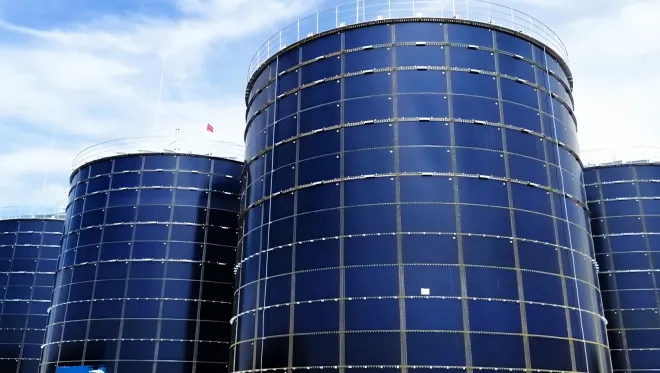
A welded steel water tank uses precision-stamped panels joined by argon-arc welding during installation. JOVIA’s welded panels have a rounded surface design and are available in SS304/2B or SS316L.
One important benefit is space utilization. JOVIA states that welding can be completed from inside the tank, reducing the need to reserve working clearance around the external walls. This can help in basements, plant rooms and other restricted spaces.
The published maximum height for JOVIA’s welded configuration is 6.5 metres. C-channel external reinforcement is required when the tank exceeds 5.5 metres. Panel thickness and reinforcement must be adjusted according to tank height because water pressure is higher near the bottom.
Welded construction can form a continuous tank body, but installation quality remains critical. Panel alignment, welding procedures, inspection and cleaning should all be included in the project plan.
Bolted Stainless Steel Water Tanks
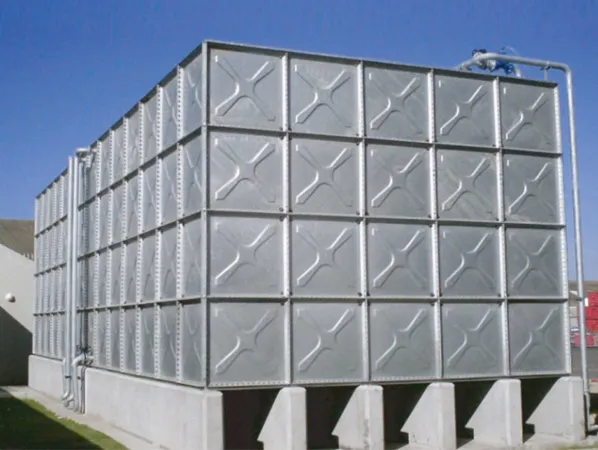
A bolted tank is assembled from prefabricated panels using bolts, sealing materials and structural supports. JOVIA’s bolted panels use an X-shaped profile and are available in SS304/2B and SS316L.
Because the panels are mechanically connected, bolted construction can reduce the amount of welding required at the project site. Individual panels can be packed efficiently, moved through restricted access routes and assembled at the final location. This is useful where a one-piece tank cannot be delivered.
JOVIA lists a maximum height of 5 metres for this configuration and specifies I-beam external reinforcement at that height. Buyers considering bolted stainless steel tanks should still verify tank capacity, internal bracing, foundation loading and connection positions.
Neither structure is universally better. Welded tanks may suit sites with minimal external clearance, while bolted tanks may be more practical where modular transport and assembly are priorities. When cost, fire-water duty and modular installation take priority over stainless hygiene, a hot dipped galvanized pressed steel tank may be a practical alternative.
SS304 vs SS316L Water Tanks
Both grades are available for JOVIA’s welded and bolted sectional tank configurations. The correct choice should reflect water chemistry, operating temperature, surrounding environment and project specifications rather than price alone.
A stainless steel 304 water tank can be considered for general water-storage projects when SS304 meets the required material and water-quality standards. A stainless steel 316 water tank may be specified when the project design or operating conditions require SS316L.
The supplier should review factors such as chloride levels, cleaning chemicals, temperature and external exposure before confirming the material. Buyers should not automatically specify SS316L for every project or choose SS304 solely because it has a lower initial cost.
Tank Capacity, Supports and Accessories
A stainless steel water storage tank should be sized from usable storage requirements. Engineers may need to consider daily demand, refill rate, emergency reserve and applicable project regulations.
JOVIA states that its modular panel system can be assembled into volumes ranging from 0.125 m³ to 5,000 m³. Final dimensions must still fit the available length, width and height at the installation site.
A complete tank package may include:
Inlet and outlet flanges
Overflow and drain connections
Manhole and inspection access
External ladder
Horizontal tie rods and vertical supports
C-channels or other reinforcement
Painted or hot-dip-galvanized base frame
JOVIA lists SS304/2B or SS316 as options for internal structural components, ladders and flanges. These details should be clearly identified in the quotation because they affect installation, maintenance and total project cost.
A low stainless steel water tank price may exclude important supports, fittings or accessories and therefore may not represent the complete installed cost.
What Buyers Should Ask a Stainless Steel Water Tank Supplier
When requesting stainless steel water tanks for sale, buyers should provide:
Required usable capacity
Available installation dimensions
Indoor or outdoor location
Stored-water quality and temperature
Preferred SS304 or SS316L grade
Welded or bolted construction preference
Pipe sizes and connection positions
Foundation details
Delivery and installation scope
A professional stainless steel water tank supplier should return a general arrangement drawing showing the tank dimensions, panel layout, supports, connections and access points. The quotation should also define the included components, packing method and available installation guidance.
Projects comparing several materials can review JOVIA’s broader storage tanks range, which includes GRP, hot-dip-galvanized, stainless steel, corrugated steel and coated-steel storage solutions.
FAQ About Stainless Steel Water Tanks
What is the difference between welded and bolted stainless steel tanks?
Welded tanks use stamped panels joined by on-site welding. Bolted tanks use prefabricated panels, bolts and sealing materials. The appropriate option depends on site access, available working space, local installation capability and project schedule.
Is SS316L always better than SS304?
Not necessarily. SS316L may be specified for particular water conditions or project standards, while SS304 can be appropriate for many general water-storage applications. The decision should be based on actual operating conditions.
Can a sectional tank be used as a stainless steel water pressure tank?
A standard sectional tank is intended for atmospheric storage and should not automatically be treated as a pressure vessel. A stainless steel water pressure tank requires a separate pressure-rated design and the applicable testing or certification.
Can these tanks store hot water?
The operating temperature must be confirmed with the manufacturer. A steel hot water tank may require different materials, structural provisions, welding procedures, sealing systems or insulation from a standard cold-water storage tank.
What information is needed for an accurate quotation?
The manufacturer needs the required capacity, installation dimensions, material grade, construction type, water conditions, connection layout, delivery location and required services. Detailed project drawings produce a more reliable quotation than requesting only a general price.
Conclusion
Stainless steel water tanks can provide hygienic and corrosion-resistant storage for drinking water, food-related operations and other commercial or industrial applications. Their suitability depends on matching the stainless steel grade, panel structure and reinforcement system to the actual project conditions.
JOVIA supplies welded and bolted sectional tanks in SS304/2B and SS316L, with configurable panels, supports, flanges, ladders and base frames. Buyers can submit capacity, site dimensions, water conditions and connection requirements to obtain a project-specific design and quotation from a stainless steel water tank manufacturer.
 English